

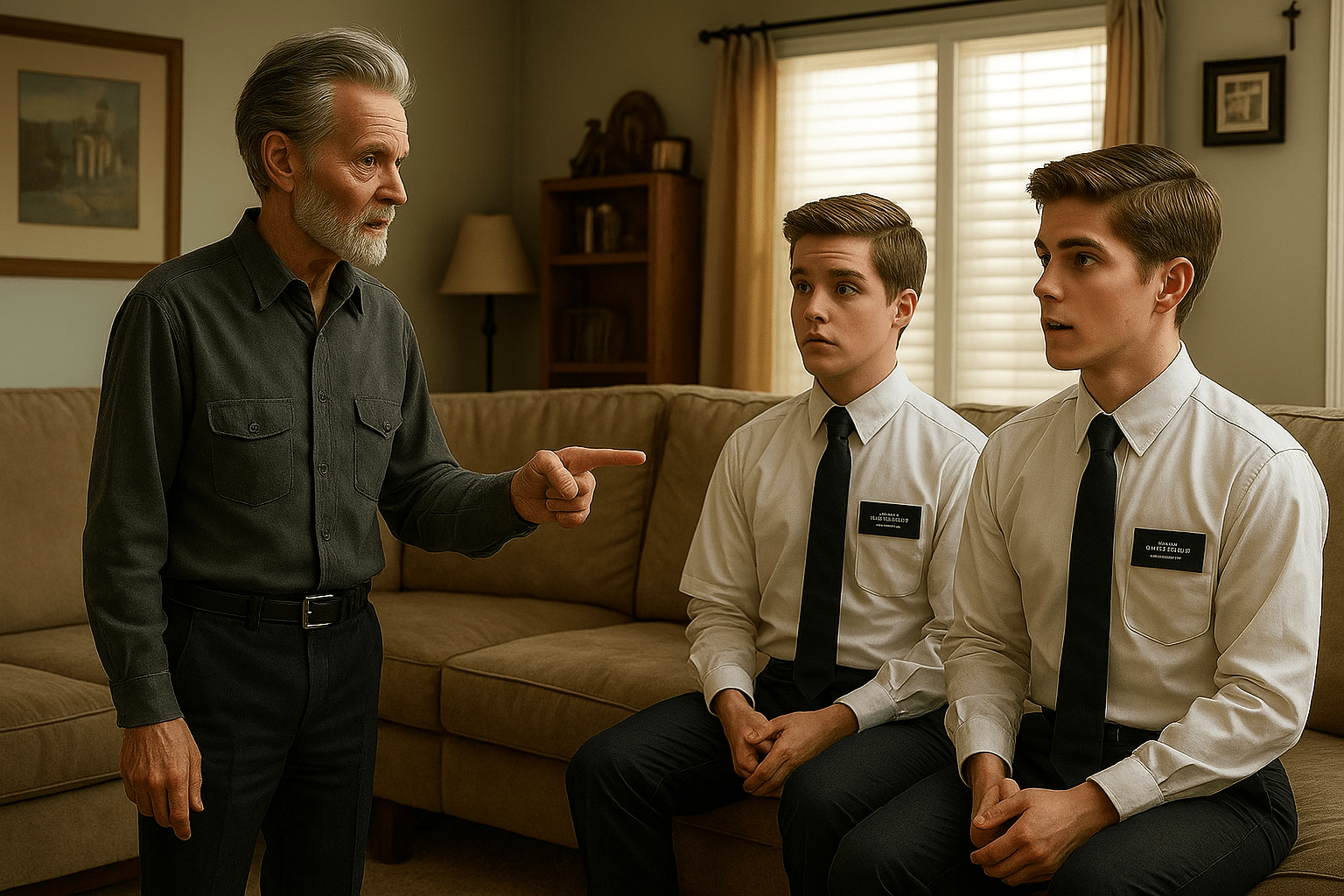
In the latter part of serving my LDS mission the church decided to revamp methods of ways in which we teach and approach people. Several zone conferences and district meetings centered around these new methods and emphasis. Prior to rolling out training to the whole mission, the mission leadership, namely the Assistants (APs, Apes, or whatever name is your preference) went on exchanges with missionaries that were close to the mission home at the time to train missionaries on these new methods. So it was my lot one fated day to host one of the Apes in my area and take him around to see the people we were teaching and also do some door to door.
If you’ve read my first blog post you’ll understand my true conversion to Jesus Christ came early on in my mission and that moment drove me to focus on Jesus Christ when meeting and teaching people. When we were going door to door on this particular morning I led the conversations speaking to people that answered their door. My approaches were always centered on Jesus. Whether it was asking someone if they believe in Jesus Christ, or if they knew he was their Savior. At one point I must’ve struck a nerve with this Ape. After one particular encounter he seemed annoyed but obligated to fulfill his noble duty as my leader and stated “Why do you keep talking to everyone about Jesus? We aren’t here to tell people about Jesus. We are here to tell people about the true church and living prophets”.
It was an odd thing to say to me from my perspective, considering we were acting as representatives of his “true church” as we were told. I didn’t take the time to argue but rather carried on to an appointment we had scheduled with an elderly man named Jack. I had met with Jack before. Nice guy. Devout Christian. Prior meetings yielded deep discussions that you don’t come by all too often with other Christians. This was my area and likewise my responsibility to meet with and talk with people as inspired. I looked forward to a good conversation with Jack on this day, however my noble leader was on a mission to show me the “right way” to “teach” people. He dominated the conversation with Jack, he didn’t allow me to speak. He pulled out every stop. Every sales tactic, every method of manipulation one could think of on Jack to try and get him to commit to Baptism. Meanwhile, I was thinking no wonder why the mission president chose this guy as Head Sales Rep. He doesn’t take “No” for an answer. At some point long into this interaction it was getting to be too much. The Ape wasn’t going to leave until he got a baptismal commitment. Finally Jack stood up and exclaimed, “I do not need to be baptized into your church! I already know that when I die, I will die as a saved individual!”. He proclaimed this with such conviction that the confident and eloquent salesman became a defeated silent little man.
The mission’s most recognized and top salesman couldn’t make the sale of the “one true church” to a humble follower of Jesus Christ. But why? Faithful LDS may argue that Jack wasn’t humble enough to be converted. But the truth is likely closer to the concept of – if you already have something, why would you purchase the same thing twice if your needs are met? Think about those times you step into a store like Walmart or any other large retailer that is similar. You are likely there to purchase something you decided you already needed. You’re walking down the aisle near the electronics, and you see one of the phone carrier salespeople just waiting for you to pass by. Maybe you avoid eye contact or try to seem distracted with something else, because you already know that you have what you need, and don’t need to talk with them. Despite your best efforts of avoidance they boldly greet you. Because you are a nice and polite person you stop to greet them back. You’ll politely tell them that you already have a great phone carrier at a great price and have no need to switch carriers. It’s reasonable to think this answer will satisfy the salesperson, but they’ve heard it many times. Sure, maybe the coverage you already have is the same or better, but maybe they can match your price. Or maybe a new free phone is enough to convince you to switch carriers. This is called an incentive to switch even if there aren’t any extra benefits outside the incentive to change carriers. Regardless of the free incentive, the fact remains that once you make the decision to switch, the sale is made, and you are now paying your new carrier that offered the free incentive. Simply put, you indirectly end up funding the incentive that was sold to you as “free”.
In the church, when we go on missions, we have enough conviction in our church and beliefs that we are willing to pay our own way and dedicate up to 2 years of our life solely to the church and its mission. We attend the MTC that builds us up as the Lord’s “servants” doing the Lord’s work to bring about the salvation to his children that couldn’t have it otherwise without the church. We are told that we’re not mere salesman, but official representatives of Christ authentically helping others. I personally took this to heart at the time.
It was years after my mission I found myself in part of my career in a position where making sales was essential. At this time I was fully active in the church. For this position, I attended a month long training all focused on sales, and how to interact with people to make the needed sale. One day, when I was interacting with real clients, it just hit me. I’m literally using the same tactics for sales that I was told to use while I was on my mission. It was one of those surreal moments of what I didn’t realize at the time was cognitive dissonance that commonly happens to active, faithful members of the LDS church.
The question came, what did I sell on my mission? Generally speaking, I was selling salvation. Isn’t that what religion sells in general? Is Salvation the incentive or the actual product?
When a missionary concludes their sales pitch, they ask a person to pray about the things that are being taught. Often Moroni Chapter 10 is used as part of this pitch:
“And when ye shall receive these things, I would exhort you that ye would ask God, the Eternal Father, in the name of Christ, if these things are not true; and if ye shall ask with a sincere heart, with real intent, having faith in Christ, he will manifest the truth of it unto you, by the power of the Holy Ghost.
And by the power of the Holy Ghost ye may know the truth of all things.” (Moroni 10:4-5)
A missionary might say something like “Don’t take our word for it, pray about it, and through the power of the Holy Ghost, God will tell you that our message is true”. If the person being taught remains interested, they will be taught other things that become part of the greater sales pitch. The end goal is baptism into the church. So if the product being sold is salvation, what is the incentive? The incentives become more clear as the sale needs to close.
In the first lesson, the missionaries teach that the Holy Ghost is the way to determine truth. This is correct. I love the simple truth Moroni explains that we can know the truth of “all things” by the power of the Holy Ghost. In later lessons, the missionaries shift gears to offer incentive. You know that Holy Ghost they mentioned that will teach you all truth? Well, that only works for you when it benefits the church. It will only tell you that the church and what the missionaries taught is true. You don’t get that privilege all the time unless you join the church. The incentive. But is this incentive only truly available exclusively through membership in the LDS church?
The church emphasizes that there is a difference between the “power” of the Holy Ghost and the “Gift” of the Holy Ghost. The “power” is there and only works for a “non-member” when they inquire about the truths of the church – despite Moroni’s words that the power of the Holy Ghost manifests the “truth of all things”. The church’s doctrine on this is stated in the Bible Dictionary:
“The Holy Ghost is manifested to men on the earth both as the power of the Holy Ghost and as the gift of the Holy Ghost. The power can come upon one before baptism and is the convincing witness that the gospel is true. By the power of the Holy Ghost a person receives a testimony of Jesus Christ and of His work and the work of His servants upon the earth. The gift can come only after proper and authorized baptism and is conferred by the laying on of hands” (Holy Ghost, LDS Bible Dictionary)
The Power works to benefit the church to convert individuals before baptism. The Gift is only available to members of the church after an individual has been baptized into the church and has had hands laid on their head to confer it. What is different about the Gift as defined by the church? The Bible Dictionary continues:
“The gift of the Holy Ghost is the right to have, whenever one is worthy, the companionship of the Holy Ghost. For those who receive this gift, the Holy Ghost acts as a cleansing agent to purify them and sanctify them from all sin. Thus it is often spoken of as “fire” ” (Holy Ghost, LDS Bible Dictionary).
The church focuses on the “companionship” aspect of the Gift of the Holy Ghost and the mechanism by which to obtain it in it’s teachings:
“Baptism by water must be followed by baptism of the Spirit to be complete. When we receive both baptisms, we are cleansed of our sins and are spiritually reborn. We then begin a new spiritual life as disciples of Christ.
We receive the baptism of the Spirit through an ordinance called confirmation. This ordinance is performed by one or more priesthood holders who lay their hands upon our head. First they confirm us a member of the Church, and then they confer the gift of the Holy Ghost upon us.” (Preach My Gospel, Ch. 3 – The Gospel of Jesus Christ, The Gift of the Holy Ghost)
Though rarely emphasized, I acknowledge that the church acknowledges the Gift of the Holy Ghost as a baptism of fire, and cleansing – to an extent. But notice how this is only possible through a church ordinance or ritual? You can be granted a “remission of sins” but only after one of the church’s “priesthood holders” lays hands on your head. You can have access to the Holy Spirit, but only after a priesthood holder allows this. Is this incentive to join the church just a sales tactic that God came up with to join a church? Did you ever have a defining moment in your life where you felt the cleansing power of the Holy Ghost? Or did you take the incentive offer the church gave you when you either converted, or were an eight-year-old child that this ritual “washes away your sins”? Is this conversion to a church, or to Christ?
Aside from forgiveness of sins through ritual, what does this companionship that the church promises entail? If we want truth, Moroni states we can find truth through prayer at any time. The church doesn’t really offer any scriptural basis for this companionship doctrine. The church even distinguishes this companionship doctrine from what the scriptures call the “light” or “spirit” of Christ, which is defined in the scriptures as:
“For behold, the Spirit of Christ is given to every man, that he may know good from evil; wherefore, I show unto you the way to judge; for every thing which inviteth to do good, and to persuade to believe in Christ, is sent forth by the power and gift of Christ; wherefore ye may know with a perfect knowledge it is of God.” (Moroni 7:16)
If God has freely given the spirit of Christ to “every man” and allows us to pray to him to learn the “truth of all things”. What really is this companionship doctrine that the church offers as incentive to join with the church? I cannot find a scriptural precedence for it. I cannot find a scriptural precedence for men in church leadership to be gatekeepers of the necessary access to the Holy Ghost. John the Baptist even emphasized that the “baptism of fire” comes through Christ:
“I indeed baptize you with water unto repentance: but he that cometh after me is mightier than I, whose shoes I am not worthy to bear: he shall baptize you with the Holy Ghost, and with fire” (Matthew 3:11, KJV).
John performed water baptism by virtue of being a descendant of Levi. He stated that Christ is the one who baptizes with fire, or what the church calls the “gift of the holy ghost”. It is further evident in his baptizing of Jesus that the baptism of fire didn’t come by virtue of a man’s ritual performance of laying on of hands:
“Then cometh Jesus from Galilee to Jordan unto John, to be baptized of him.
But John forbad him, saying, I have need to be baptized of thee, and comest thou to me?
And Jesus answering said unto him, Suffer it to be so now: for thus it becometh us to fulfil all righteousness. Then he suffered him.
And Jesus, when he was baptized, went up straightway out of the water: and, lo, the heavens were opened unto him, and he saw the Spirit of God descending like a dove, and lighting upon him:
And lo a voice from heaven, saying, This is my beloved Son, in whom I am well pleased.” (Matthew 3:13-17, KJV)
Jesus went to John in humility to be baptized by water to show his devotion to God. What happened afterward? The Spirit descended, without mention of “laying on of hands” Perhaps that is because laying on of Hands isn’t the decisive factor or mechanism of this spiritual moment. I acknowledge a core part of the early doctrine of the restoration mentions “laying on of hands for the gift of the holy ghost” (Joseph Smith, Wentworth Letter). We are also reminded in early restoration teachings that “many are called, but few are chosen” (Doctrine and Covenants 121:40, LDS Edition). Suffice to say, one can have hands laid on them all day every day, but the baptism of fire is for Christ to impart on an individual. Christ is not restricted or bound from imparting the spirit to someone if a man does not lay hands. Rituals are just that, rituals. They are a form of worship to show God you want more from Him, it is not a mechanism that unlocks access. Men that lay on hands should have power from and faith in the Lord to uplift one in their quest to obtain this baptism. Even David Bednar, LDS Church apostle, (despite his appeals to “priesthood authority”) once mentioned that the command to “receive the holy ghost” in the confirmation ritual is essentially just that – a command to the individual to live in a way to actually receive the Holy Ghost:
“These four words—“Receive the Holy Ghost”—are not a passive pronouncement; rather, they constitute a priesthood injunction—an authoritative admonition to act and not simply to be acted upon.” (David A. Bednar, Oct. 2010 General Conference, Receive the Holy Ghost).
Scripture provides a moment where one man became fully converted to Christ, and received this baptism of the Holy Ghost, or Baptism of Fire. No mention of a middle man between the individual and Christ – but a man humbly and earnestly seeking Christ, and Christ answering. Enos in the Book of Mormon relayed his experience as such:
“And my soul hungered; and I kneeled down before my Maker, and I cried unto him in mighty prayer and supplication for mine own soul; and all the day long did I cry unto him; yea, and when the night came I did still raise my voice high that it reached the heavens.
And there came a voice unto me, saying: Enos, thy sins are forgiven thee, and thou shalt be blessed.
And I, Enos, knew that God could not lie; wherefore, my guilt was swept away.
And I said: Lord, how is it done?
And he said unto me: Because of thy faith in Christ, whom thou hast never before heard nor seen. And many years pass away before he shall manifest himself in the flesh; wherefore, go to, thy faith hath made thee whole“ (Enos 1:4-8)
We don’t know much about Enos’s story prior to this, maybe he was baptized by water at some point and maybe he did have hands laid on his head. But it was this moment that was his defining moment of conversion and baptism of fire. Earnest prayer in the forest, on his own, and the Lord answered.
A “Gift” is given freely. It’s not meant to be part of a sales pitch, paid for with money by the receiver, or given as an incentive to join an exclusive club, or organization. Jack didn’t want what my mission leader was selling. Not because Jack was hardhearted and prideful, but because Jack already obtained freely from Christ what the AP Salesman was offering as incentive to join the club. Jack had conversion to Christ. He felt in his heart that Christ had made promises to him. What benefit would there have been to Jack to join an organization that saw his conviction and prior conversion as invalid? – to “try again” through its exclusive rituals only to then be confined to the limited teachings of men. Teachings that place men between you and your Savior. These restrictive teachings prevent true conversion to Jesus or baptism of fire.
The path to conversion in the church is essentially this: To receive the gift, you must use the gift you haven’t yet received. But on the contrary – if you already have this gift, then you don’t need them to give it. Truly, It is faith sold as a paradox, not a promise.
Jesus kept it simple in stating:
“But the Comforter, which is the Holy Ghost, whom the Father will send in my name, he shall teach you all things, and bring all things to your remembrance, whatsoever I have said unto you” (John 14:26, KJV)
Jesus adds later that the Holy Ghost’s witness is centered around being a witness of Christ:
“But when the Comforter is come, whom I will send unto you from the Father, even the Spirit of truth, which proceedeth from the Father, he shall testify of me” (John 15:26, KJV)
He afterwards adds, that after we receive a witness of Christ from the spirit, that contrary to what my mission leader said, we are to witness of Him:
“And ye also shall bear witness, because ye have been with me from the beginning.” (John 15:27, KJV)
What is your true moment of conversion? Has there been a time in your life where you were truly baptized with the Holy Ghost and felt a cleansing from sin?
For more on Conversion and my personal experience with it. See my article entitled: Conversion – Seeking the Truth
 Plurality of Doctrines