

The Mormon Pioneers after a journey of a little over three months entered the Salt Lake Valley on July 24, 1847. According to William Clayton, upon arrival Brigham Young the pioneer leader stated, “This is the right place, Drive on”. Narrative goes that like earlier Mormon history, the Mormons were driven out of their home due to persecution. The exact reasons for their leaving their home in Nauvoo is hard to prove definitively. There were accusations of counterfeiting and other illegal activities occurring in Nauvoo, where the majority of the Mormons fell out of favor in Illinois. We do know for sure that some time after the Murders of Joseph Smith and Hyrum Smith, that the City of Nauvoo had its charter revoked due to ongoing controversy among the city’s citizenry.
Regardless of the history in dispute, the Brighamite branch of Mormons sought a place of isolation where they could practice their ambitions and religion, good or bad as they may be.
Joseph Fielding Smith, grandson of Hyrum Smith, long time LDS Church Historian, Apostle, and eventual President of the Church gives some interesting narrative and insight on some of the mechanism in place in the church in the final days of Joseph and Hyrum’s life, as well as narrative on why the Mormons in the years soon afterwards were driven out of Nauvoo. On June 23, 1844 Joseph Smith, Hyrum Smith, Willard Richards, and Aaron Johnson started on the river so they could cross and supposedly head west toward the Rocky Mountains and the Great Basin. Apparently, Joseph sent for his long time bodyguard Orrin Porter Rockwell requesting to bring horses to the other side of the Mississippi for them. However when Rockwell returned, he didn’t return with horses, he returned with a petition from Latter Day Saint followers in Nauvoo allegedly requesting that Joseph and Hyrum return to Nauvoo. The narrative states that Joseph replied to the petition as follows:
“If my life is of no value to my friends, it is of none to myself.” (Doctrines of Salvation, Volume 3, page 336)
Joseph’s alleged words at this time seem to have a feeling of defeated betrayal within. Joseph and Hyrum did indeed return to Nauvoo, and four days later, they were murdered.
All throughout Mormon history in its teachings America is perceived as a promised land. This is one of the premises of The Book of Mormon. Sometimes we use the term “Zion” as a synonym with “The Promised Land”. Brigham Young assumed leadership of a portion of the remaining church after the Smith murders. The Brighamites eventually left settlements such as Winter Quarters and Nauvoo. In doing so, they left the United States, and settled in modern day Utah, then part of Mexico. They left the figurative and perhaps literal promised land so they could practice doctrines that were not acceptable in the said promised land. Eventually the United States made Utah a territory of the country, but Utah was not granted statehood until 1896, six years after The Manifesto was given as a PR statement to appease the federal government that the church was no longer practicing polygamy. The Mormon settlement of Utah, was not allowed back into the promised land until their perverse doctrine was disavowed. That’s not the end of the story though, however. After the Manifesto was given, the church still couldn’t let go of the doctrine completely. Once again, some members of the church were asked again to leave “the promised land” of America, and continue some polygamy southward in colonies in Mexico. Through these examples, a continuous pattern emerges that in order to practice sinful doctrines, church members seek to leave the figurative Zion to perpetuate practices that alienates them from God.
In LDS culture, since its settlement and with the centralization of the church in Salt Lake City, the state of Utah has been perceived as this type of Zion, or promised land for LDS church members. It’s essentially Mormon Mecca in a way. Pilgrimage is an important tenant of Islam. Muslims are told they need to make a pilgrimage to Mecca at least once in their lifetime. The church holds general conference twice a year. At each time, Salt Lake City becomes a prime tourism spot for those church members that live out of state, and even out of country. People fulfill the life long dream of converging on Salt Lake City to meet with fellow church members in the conference center across the street from the oft romanticized Salt Lake Temple that seems as a castle from fairytale.
In context of this sentiment, Isaiah 2:2 is often cited as the reference for Utah being this “Zion”:
“And it shall come to pass in the last days, that the mountain of the Lord’s house shall be established in the top of the mountains, and shall be exalted above the hills; and all nations shall flow unto it.” (Isaiah 2:2, KJV)
As a faithful member, it’s easy to proudly reference this scripture and feel vindicated that you are part of Old Testament prophecy. But lets examine this further.
Anyone that lives on the Wasatch Front, or the greater Salt Lake area, is aware of the geographical nuances of our environment in living here. General Conference is convened in the beautiful months of April and October. In the winter months in between we suffer from terrible air quality and what’s called an inversion, that holds air pollutants in the valley and prevents them from escaping. This recent winter as I was driving along I-15 one morning, suddenly we entered this stretch with such low hanging, thick smog, you could no longer see the sun shining. You could feel the effect on the lungs, my eyes were burning.
I silently thought to myself, how can this be the promised land with this pollution? When we watch general conference, we’re seeing camera’s panning temple square in spring time or the Fall season, when the inversion has yet to set in. We’re only to see what appears to be good.
When we often don’t seek to see things in a spiritual manner, God often sends us physical reminders in hopes to get our attention. With modern urbanization, we might quickly shrug off the pollution of Utah as a more recent issue to deal with, the result of prosperity gospel’s quick expansion because of our faithfulness here. The truth is, the Salt Lake Valley was very much unpolluted before Brighamite Settlers. Early on in settlement, the air quickly became polluted, and a haze consistently filled the sky over Salt Lake City (A History of Air Quality in Utah – Utah.edu). In Modern times , the only way to essentially escape the smog, is to travel up, into the mountains, and if it’s bad enough, you may need to summit to the tops of the mountains via a hike. Those that do so often photograph the clarity at that elevation, and look down upon the valley that is unseen due to the blanket of smog over it.
So what is the point of all this preface so far?
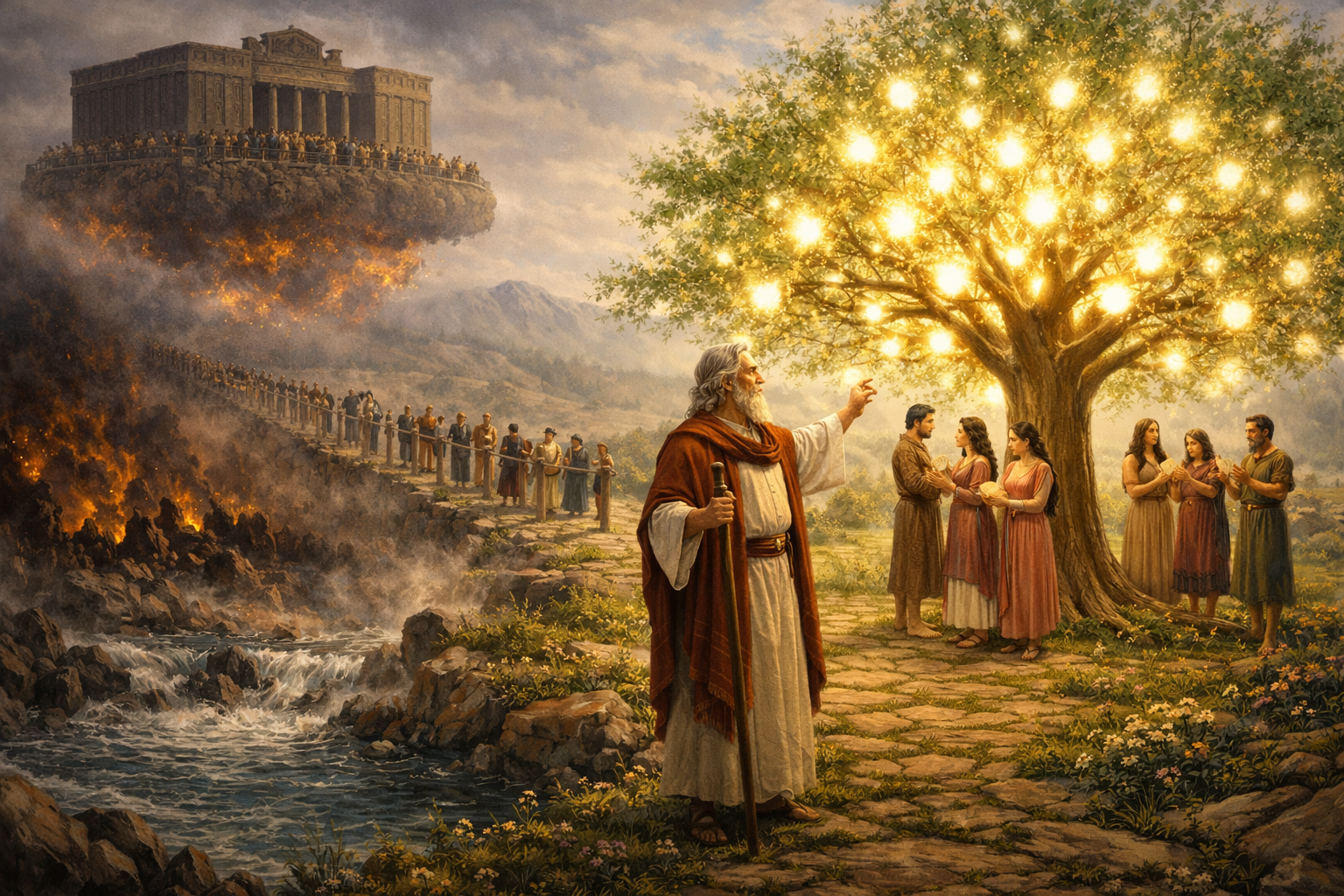
The Book of Mormon contains my favorite story in scripture. In 1 Nephi 8, Lehi gathers his family to tell them of an important dream he had. As I drove through real life smog, I remembered many of the words of Lehi. As a reminder, lets list some key aspects of the dream. Lehi finds himself in “a dark and dreary wilderness” (v. 4). There is a large and spacious field (or a valley)(v. 9). A tree whose fruit was desirable to make one happy (v. 10). A river (v. 13). A rod of Iron that extended the length of the river, a straight and narrow path that leads to the tree (v. 20). Mists of Darkness (v. 23). Notably a “great and spacious building and it stood as it were in the air, high above the earth (v. 26).
Some took hold of the rod, representative of the word of God so the they could be led to the tree which contained the most desirable fruit. Some were steadfast in holding to the word of God, but in that floating great and spacious building, there were people mocking and pointing fingers at those people that were trying to follow the word of God. This caused some who started on the path to feel ashamed, and essentially were lost (v. 27-28). Those that were steadfast and made it to the tree decided to pay no attention to those from the great and spacious building, that were mocking. But others actually sought the great and spacious building (v. 31). After all, it was great and spacious, the people there had something to be proud of.
In the dream we essentially see that we have people in different stages in their life journey. We have people in the building, thinking they have already made it in life. They are set, they are saved. We have people that are lost. We have people seeking the tree (Christ), but people are making fun of them, and that’s hard, but the mist of darkness is also thick, so they get lost once they let go, because that light Christ provides is no longer there to help them see clearly through the smog. We have those that persevere on the straight and narrow, refusing to let go of the Iron Rod (The Word of God, also Christ), and because of their finding Christ, what those in the building say of them no longer matters. They have Christ’s Light, they can see clearly through the darkness of the world.
In Old Testament narrative, the world became so wicked that in Noah’s day he caused the whole earth to be flooded. Noah was called by God to build an ark to help those that wanted to be spared to have a means to live through the coming peril. But beside a few of his family, people refused, and the wicked were destroyed. Not long after the flood, wickedness returned to the earth. What happens next is interesting. Wicked people begin to build a great and spacious building, known as the Tower of Babel. The narrative states the purpose was to reach heaven. God frowned upon this, took the people of the earth from having one language, to confounding their languages and scattering them around the earth (Genesis 11). Not only was there ignorance in this method of seeking heaven, but their false ways of building a great and spacious building led to confusion, and a figurative mist of darkness clouding their judgment. From our modern perspective it seems silly to build a building in order to reach heaven, that’s not how God works. Some scriptural scholars in the past have offered an alternative way of thinking about this story though. What if those building the Tower of Babel knew they were wicked. Because of the proximity in time to the flood, what if these people feared that because of their wickedness, that God would flood the earth again. What if a very high tower was their way of trying to escape the judgments of God?
When we compare this to Lehi’s dream, the great and spacious building was full of proud people. They had no reason to seek the tree. Their own accomplishments and their own construction of that massive building kept them safe, and offered everything they desired. They were “saved” already. The Zoramites in similar manner cast out their poor, built a holy stand called the Rameumptom, and sent prayers to God thanking him from it that they were his chosen and favorite people (Alma 31).
In 2019 the LDS Church closed down the Salt Lake Temple to begin major renovations costing approximately three billion dollars. The main premise was structural upgrades. The portion that has received most attention is the seismic upgrades for the temple. The church has poured massive amounts in cash to essentially “earthquake proof” the temple. Keep in mind, the LDS view temples as literally the house of God. Is there some underlying fear that God would destroy his own house? There is a fascinating concept to the seismic upgrades though. The church is implementing “Base Isolators” to earthquake proof the temple. It is a complex engineering feat. To the lay man though, what this entails deserves attention. The Temple is essentially being removed from it’s fixed foundation in the earth, and being isolated from it. It is essentially floating above the base isolators that would absorb the shaking in the event of an earthquake, allowing the temple to move freely to avoid any extensive damage.
About a year after the commencement of renovations, on March 18, 2020 a 5.7 Earthquake struck the Salt Lake Area. In a major moment of irony, the trumpet belonging to the Angel Moroni atop the Salt Lake temple left his hands and fell the ground. The trumpets symbolic nature of sounding for everyone to hear the gospel, was removed from the church’s centralized and beloved building. Was this an act of God telling us something?
I recall watching the October 2021 general conference, and was astonished as the remarks made by then President Russell M. Nelson:
“We are sparing no effort to give this venerable temple, which had become increasingly vulnerable, a foundation that will withstand the forces of nature into the Millennium.”
These remarks came after explaining the problems with the temples then foundation. Is there reason to fear greater the judgements of God rather than placing faith in him? If we fear that we cannot repair the foundation, or that even if we do or do not, that God will not preserve his own house? Is the best course of action to litigate against God and say, if you do not preserve us or our foundation, we’ll take away the foundation all together so even you cannot destroy the temple? The pride seemingly went further that even my faithful LDS mindset was uneasy. He stated:
“My dear brothers and sisters, when renovations on the Salt Lake Temple are completed, there will be no safer place during an earthquake in the Salt Lake Valley than inside that temple.”
Immediately came to mind was the story of the Tower of Babel, and the pride in the works of men to avoid the judgments of God. Many questions arise in these sentiments. Does God care so much about his physical edifices on earth, that billions of hard earned funds from faithful donators need to be used in order to keep them intact?
Next year, when the Salt Lake Temple re-opens for only the LDS faithful attend after its dedication, think about the implications and prophecies from the scriptures before. To those of living in Utah, we will be inserted into a quite literal manifestation of Lehi’s dream. We will have smog, and mists of darkness surrounding us, clouding our sight and ability to see clearly. We will have a great an spacious building, floating in the air, filled with people that think their way and exclusive ritual is superior to those seeking Christ directly. The only way to clarity in this literal mist of darkness is to ascend out of the valley, to the actual Top of the Mountain. In the mountain tops is where Jehovah visited Moses. Where Jesus along with Peter, James and John received heavenly visits, Where Nephi ascended to be shown by the Lord how to reach the promised land. God built the mountains himself and asks us to ascend and seek him. Man-made structures will not save us, or bring us in proximity to God.
So did those that follow Brigham Young into the Salt Lake Valley really ascend to the tops of the mountain or the “mountain of the Lord’s house”?
The Brighamites left behind the fertile banks of the Mississippi in Nauvoo and settled in a desert valley in which was home to a massive lake of great salinity, that is essentially devoid of life within. The only nourishment that the valley is provided is from the streams and rivers that come from the top of the mountains, that after being used settles in the Great Salt Lake in the valley, and offers no quenching of thirst if partaken, but rather sickness.
Perhaps the prophet Jeremiah put it best as follows:
Thus saith the Lord; Cursed be the man that trusteth in man, and maketh flesh his arm, and whose heart departeth from the Lord.
For he shall be like the heath in the desert, and shall not see when good cometh; but shall inhabit the parched places in the wilderness, in a salt land and not inhabited. (Jeremiah 17:5-6, KJV)
In 2 Nephi 28, in a discourse which condemns putting trust in man, the following is said:
“And others will he (Satan) pacify, and lull them away into carnal security, that they will say: All is well in Zion; yea, Zion prospereth, all is well—and thus the devil cheateth their souls, and leadeth them away carefully down to hell” (2 Nephi 28:21).
In poetic irony, William Clayton, the man who recorded Brigham’s famous quote shared at the beginning of this article, penned a hymn each member of the LDS Church is familiar with entitled: “Come, Come, Ye Saints”. This hymn was written specifically as a motivator for the Brighamites as they journeyed out of Nauvoo. The beginning of the fourth verse starts:
“And should we die before our journey’s through, Happy Day! All is well!”
So I end this article with a question. Is all well in Zion?
 Plurality of Doctrines